Tuesday, August 7, 2007

Manuscript Decoration

Spanish Calligraphy - Caso quadrado para principios


Spanish Calligraphy - Caso quadrado para principios (detail)


Spanish scriptorium manual - T. de tracos


16th century typography - Menor letra de copistas


Spanish calligraphy manual - punto letra el mismo tamano


letra de aldo


punto quadrado (minimas) - 16th century musical illumination


menor letra redonda cortada - illumination techniques


letra de copistas - manuscript illumination examples


Spanish calligraphy - casos quadrados - Plimpton MS 296


Spanish calligraphy - casos quadrados - Plimpton MS 296 (detail)


medieval calligraphy - letra de junto


casos prelongados - Spanish calligraphy


casos prelongados - Spanish calligraphy (detail)


Plimpton MS 296 from the Rare Book and Manuscript Library at Columbia University
(part of the Digital Scriptorium).

This Spanish parchment manual for calligraphers/copyists was made between 1500 and 1515. Unfortunately, that is all the information available. Twelve of the thirty one pages have been digitised (eleven are shown above).

While looking around fruitlessly for further information, I came across a site put together by the Department of Medieval Studies at Central European University in Budapest - Medieval Manuscript Manual (available in four languages). It's a basic overview of manuscript production (types, techniques, inks, typology etc) aimed at a non-professional audience and includes a useful glossary.

Sunday, August 5, 2007

American Civil War Envelopes

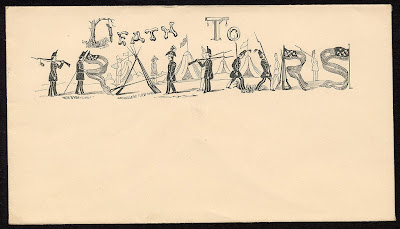
Death to Traitors typographic envelope

'Death to Traitors'
E. Cogan
"Soldier figures, hanged men and American flags make up the phrase 'Death to Traitors'."
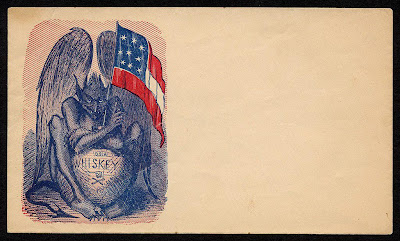

Devil and Whiskey - civil war cover

'Devil and whiskey'
"Devil sitting hunched over a whiskey barrel holding a flag."
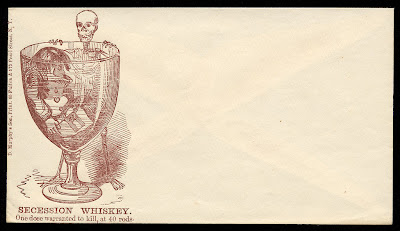

Secession Whiskey - devil in civil war cachet

'Secession Whiskey'
D. Murphy's Son
"A giant goblet being hovered over by a skeleton. Inside the goblet is a pudgy, drunk (sleeping?) person. White envelope with brown ink. Image on left side.
One dose warranted to kill, at 40 rods."
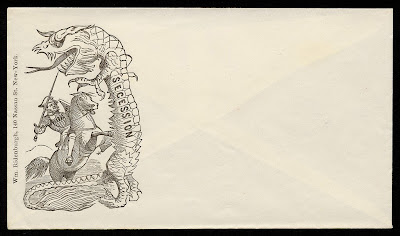

Civil War secession as a dragon

'Secession as a dragon'
William Ridenburgh
"A knight wearing the American shield fights a dragon labeled 'secession'."
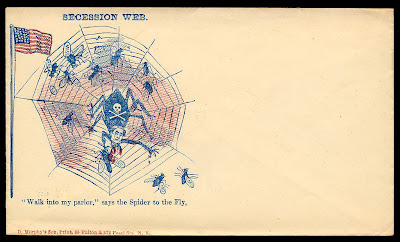

Secession Web - civil war caricature

'Secession Web - "Walk into my parlor," says the Spider to the Fly.'
D. Murphy's son, printer
"Davis as a spider catching the secession states in his web strung from the American flag. There is a skull and cross bones on his spider back and he is dripping blood and clutching Virginia. "
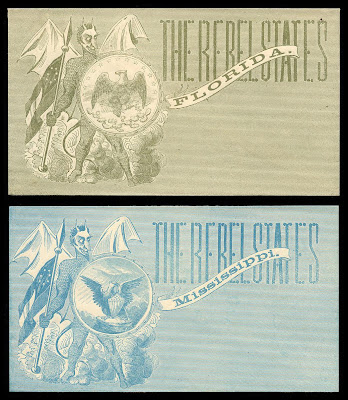


The Rebel States - Florida and Mississippi

'The Rebel States'
Reagles & Co., copyright holder
The devil holds the state seals of Mississippi and Florida and a Confederate flag.
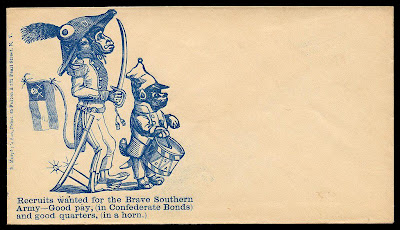

Civil War envelope - Southern army propaganda

'Recruits wanted for the brave southern army - good pay, (in Confederate Bonds ) and good quarters, (in a horn.)'
D. Murphy's Son
"A dog and a monkey dressed in Confederate uniforms. The dog plays a drum. The monkey has a sword drawn and a flag showing stripes and skull and crossbones tied to his tail."
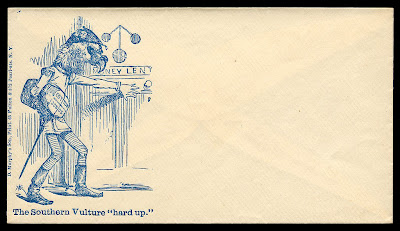

The Southern Vulture - envelope caricature

'The Southern Vulture "hard up".'
D. Murphy's Son
"Confederate soldier with rooster's head entering a pawn shop carrying a bail of cotton."
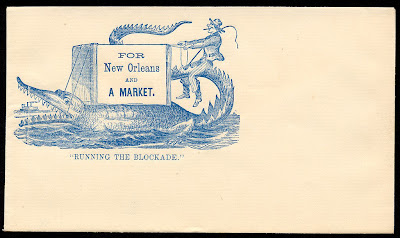

Running the Blockade - civil war/alligator satire

'Running the blockade'
"Man riding on the tail of an alligator with a crate labeled 'For New Orleans and a market'."
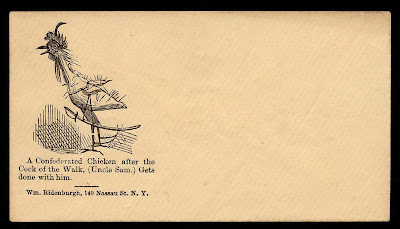

Confederated Chicken - civil war illustrative propaganda

'A Confederated Chicken after the Cock of the Walk, (Uncle Sam.) gets done with him.'
William Ridenburgh
"A chicken missing most of its feathers with a small sword suspended from it's body."
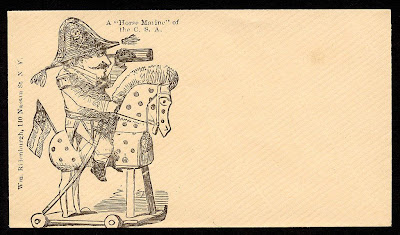

A Horse Marine of the C.S.A.

'A "Horse Marine" of the C.S.A.'
William Ridenburgh
"A plump figure with a naval hat on sits atop a wooden horse with a spyglass in his hand."
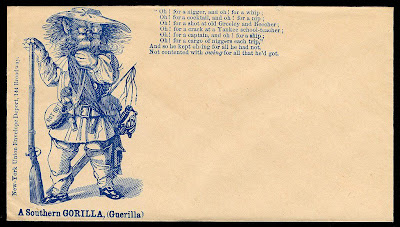

Civil War envelope - A Southern Gorilla

'A southern gorrilla, (guerilla)'
New-York Union Envelope Depot
"Gorilla (?) dressed in uniform with Confederate hat."
'Oh! for a nigger, and Oh! for a whip;
Oh! for a cocktail, and Oh! for a nip;
Oh! for a shot at old Greeley and Beecher;
Oh! for a crack at a Yankee school-teacher;
Oh! for a captain, and Oh! for a ship;
Oh! for a cargo of niggers each trip,
and so he kept oh-ing for all he had not,
not contented with owing for all that he'd got.'
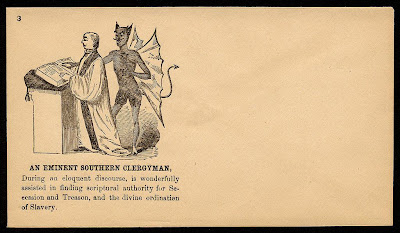

An eminent Southern Clergyman

'An eminent southern clergyman, during an eloquent discourse is wonderfully assisted in finding scriptural authority of secession and treason, and the divine ordination of slavery.'
"Clergyman at the pulpit with bible on it with the devil standing beside him. Each has one hand on the open bible."


'An ASS-sault from a "Masked" Battery'
J Magee
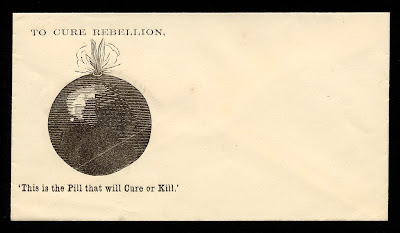

Civil war bomb propaganda envelope

'To Cure Rebellion - This is the Pill that will Cure or Kill'
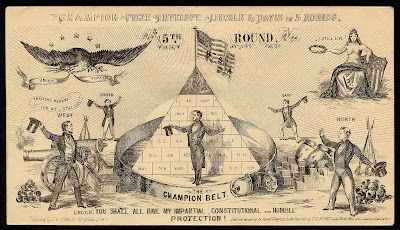

Lincoln v Davis boxing satire - civil war envelope

'Champion prize envelope, Lincoln & Davis in 5 rounds. 5th Round. '
J.H. Tingley, publisher.
"Lincoln stands inside "the champion belt" beside a pyramid labeled with all states. Outside the ring, four men, labeled east, west, north and south, waive hats. Flag, Liberty and eagle above. Cream envelope with black ink. Image covers sheet. Lincoln: You shall all have my impartial, constitutional and humble protection!"

"The printed envelope came into use in America in 1840 and was first used for advertising or satirical purposes. In the 1850s to 1860s 'corner cards,' with printing applied in the upper left-hand side of the front of the envelope, were common. By the onset of the Civil War, printed envelopes were already in use as a propaganda medium. Lithography was the main mode of printing used for envelopes, especially for colored designs. Printed envelopes were sold either as a single item or with matching paper."
The above Civil War envelopes come from the New York Historical Society collection - 490 images are available (click 'List items' top right).

Other collections - quite a bit of repetition, but they each have their merits:
I was hoping to find a descriptive essay that covered the printing, illustration and propaganda elements in something of a self contained nutshell (and maybe it's still out there) but there are various strands of interest through this lot:

Saturday, August 4, 2007

Theatrum Virtutum

Theatrum virtutum titlepage


Polish 16th cent sketch album - Illecebrar Contemptus


Theatrum virtutum - Tomasz Treter


Treter - The Theatre of Virtues


Thomas Treter - Theatrum virtutum


Theater of Virtues - 1588


Poland - Theatre of Virtues


Theatrum virtutum - Poland, 1588


Jesuits in the Theatre of Virtues


Theatrum virtutum, 1588


Theatrum virtutum by Tomasz Treter


Tomasz Treter - Theatrum virtutum, 1588


Theatrum virtutum - Polish sketch album


Theatrum virtutum - Thomas Treter's sketch album


Theatrum virtutum - dedicated to Stanislaus Hosius


Theatre of Virtues - emblems and verses devoted to Stanislaus Hosius


As the titlepage above suggests, 'Theatrum Virtutum' (The Theatre of Virtues) was something of a homage to the learned and widely respected catholic bishop and papal envoy during the Counter-Reformation, Stanislaus Hosius (1504-1579).
"He did more for the preservation of the Catholic religion in Poland than all the other Polish bishops combined. He was withal, a man of prayer, mortification, and great liberality towards the poor. Both clergy and laity looked upon him as a saint."
I presume this (latin) sketch album by Tomasz Treter from ~1588 was the draft for an engraved publication under the same title that was released soon after. Most information online is in Polish, a language which is as easily understood in the original as it is in the resultant gobbledegook from online translation. I daresay I would have passed over this work if it were in the published form, but there is something elegant about the ink and wash drawings that caught my eye. All the text is very neat and there is an index laying out the location of all the virtues in the (60-odd) pictures; no doubt it was a presentation album, although the 19th century bookplates don't provide any assistance.

Thursday, August 2, 2007

Buddha in the Far East

Tibetan buddhist album cover


lotus flowers in Buddhist sketch album


Buddhist monks


Buddhist monks in Tibetan album


sketch of Tibetan monks


monks in Tibetan sketch album


Tibetan monk ceremony


monks in Tibet sketch


20th century Tibetan sketch


Buddhist imagery


Buddhist iconic figures


Buddha


Tibetan album lotus flowers


back cover Tibetan album


From the Oriental and Judaica Collections at the Royal Library of Denmark:
" Anonymous: Ershiba fojiao zhi xiang (28 pictures of Buddhist figures)

Five sheets with handpainted Buddhist figures between two covers. Chinese or Tibetan from early 20th Century.

The figures portray Sakyamuni (Shijiamouni) his two disciple Ananda (Anantuo) and Kasyapa (Qie(ka)yebo), three guardian figurers and 18 Arhats (Luohan). Accompaning Buddha and each of the eighteen Arhat are explanatory texts.

On the bach side of the covers lotus plants and flower can be seen."